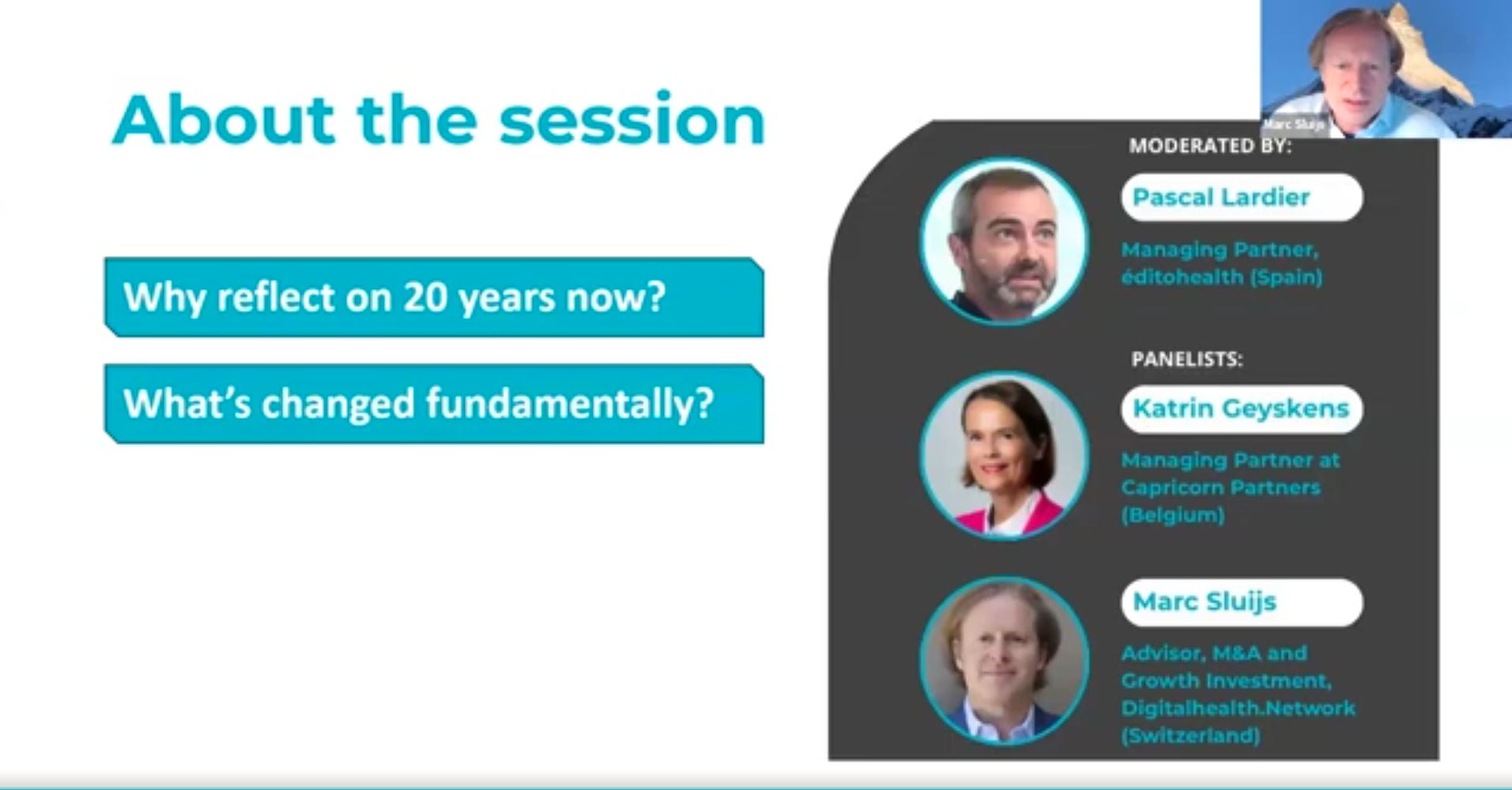
Last 25th November 2025, the webinar “20 Years of Private Investment in Digital Health: Lessons Learned and What’s Next” was organised within the HealthChain business support framework as another activity to support our SMEs business growth. It was also open to the wider digital health ecosystem to share investment-related learnings beyond the project beneficiaries.Two highly experienced digital health investors shared lessons learned from nearly twenty years of private investment, offering practical insights into what has changed, what still holds innovators back, and what it really takes to build investable and scalable digital health solutions today. In this article, we bring you the most relevant conclusions.
After two decades of development and recurring investment cycles, private investment in digital health has evolved towards greater maturity and realism. Expectations around speed of adoption, scalability, and returns have adjusted to the structural complexities of healthcare systems.
A Strong Yet Sobering Investment Landscape
Digital health funding peaked during the 2020–2021 venture capital surge, reflecting broader market dynamics rather than a sector-specific bubble. The COVID-19 crisis accelerated adoption of telehealth, remote monitoring, and digital therapeutics, reinforcing the perception that healthcare delivery had fundamentally shifted online.
However, once the acute phase of the pandemic subsided, healthcare systems largely reverted to established practices. While digital health adoption did not disappear, the pace of change slowed, and expectations were recalibrated. Despite these fluctuations, digital health has maintained a relatively stable share of total VC investment over time, suggesting underlying structural potential rather than short-lived hype.
Investors have nevertheless had to accept longer timelines. Digital health exits often take 8–10 years, compared to around five years in other technology sectors. This reflects healthcare’s regulatory requirements, complex procurement processes, and long adoption cycles, realities that require patient capital and realistic growth strategies.
Go-to-Market Reality: Technology Is Rarely the Problem
One of the most consistent lessons from twenty years of digital health investment is that technology alone almost never determines success. Instead, companies struggle with business model alignment, customer acquisition, and navigating multi-stakeholder healthcare environments.
The Finnish company Noona, a patient-reported outcome monitoring platform for oncology, illustrates this well. Initially selling directly to hospitals one by one, the company faced slow growth. Its breakthrough came when it repositioned pharmaceutical companies as commercial partners—leveraging their existing relationships with cancer centres and unlocking a much broader market.
Similarly, Open Evidence, a medical evidence platform for healthcare professionals, focused first on building strong physician adoption through an excellent user experience—long before defining a monetisation model. By becoming indispensable to clinicians, the company created leverage for future revenue streams.
These examples underline the importance of mapping value across multiple stakeholders—clinicians, hospital management, payers, and industry partners, while remaining flexible enough to adapt go-to-market strategies as assumptions evolve.
Avoiding the “Pilot Trap” When Free Comes at a Cost
A recurring challenge discussed during the webinar was the so-called “pilot trap.” Many digital health startups offer free pilots driven by hospital innovation teams without clear business ownership or budget commitment. The result is often prolonged pilot phases that fail to convert into commercial agreements.
This phenomenon—sometimes referred to as “pilotitis”—can significantly delay revenue generation and weaken investor confidence. In several cases shared during the session, pilots took years to mature into partnerships, if they did so at all.
From a market access and investment perspective, the lesson is clear: pilots should be structured with clear objectives, decision-makers, and financial commitment from the outset. Early commercial discipline is a critical factor in moving beyond experimentation towards sustainable adoption.
Bridging the Funding Chasm: From Zero to €5 Million
Early-stage funding below €5 million remains a structural bottleneck in digital health. Venture capital funds face pressure to deliver returns, limiting their appetite for early-stage healthcare risk, while larger funds typically expect significant traction before investing.
This gap is often bridged by angel investors, family offices, impact funds, and alternative financing mechanisms, many of which are more familiar with healthcare timelines and willing to accept longer horizons. Diversifying funding sources is therefore essential for extending runway and reaching meaningful scale.
Addressing this funding gap is a key focus of HealthChain’s activities under the investment pillar of the I3 Instrument, complementing innovation support with greater alignment between digital health innovators and capital expectations.
Europe’s Structural Challenge: Fragmentation and Founder Mindsets
European digital health companies often face additional challenges related to market fragmentation and limited consolidation. Many solutions are developed for local or regional contexts, making cross-border scaling difficult. At the same time, reluctance to pursue mergers or strategic partnerships can limit the creation of stronger, more competitive entities.
Overcoming these barriers requires not only capital, but also strategic openness, ecosystem collaboration, and a willingness to explore alternative growth pathways beyond organic expansion.
What Investors Consistently Look For
Despite market volatility, investor expectations have remained remarkably consistent over time:
- Clear business models, with well-defined value propositions across the healthcare ecosystem
- Strong, multidisciplinary teams, extending beyond founders
- Market realism, including a credible understanding of competition
- Stakeholder awareness, demonstrating why adoption will actually occur
Companies that address these dimensions early are better positioned to attract investment and progress towards market uptake.
From Disruption to Collaboration
Digital health has gradually moved away from disruption-driven narratives towards co-creation with healthcare organisations. Solutions developed around real operational needs and workflows tend to achieve higher adoption, even if they face challenges when scaling across diverse systems.
Balancing local relevance with scalability remains one of the central tensions in digital health—and a recurring theme in investment discussions.
Looking Ahead
Two decades of private investment show an industry that has matured but remains complex. Successful digital health innovation increasingly depends on realistic timelines, robust business models, and alignment between innovators, healthcare systems, and investors.
By embedding investment-focused knowledge sharing into its business support activities and opening them to the wider ecosystem, HealthChain supports innovators in translating co-created solutions into market-ready and investable ventures. This integrated approach contributes to more sustainable innovation, stronger ecosystems, and improved conditions for scaling digital health solutions across Europe.
▶ The full recording of the webinar “20 Years of Private Investment in Digital Health: Lessons Learned and What’s Next” is available online:
Disclaimer: HealthChain project is funded by the European Union. Views and opinions expressed are however those of the author(s) only and do not necessarily reflect those of the European Union or European Innovation Council and SMEs Executive Agency (EISMEA). Neither the European Union nor the granting authority can be held responsible for them.