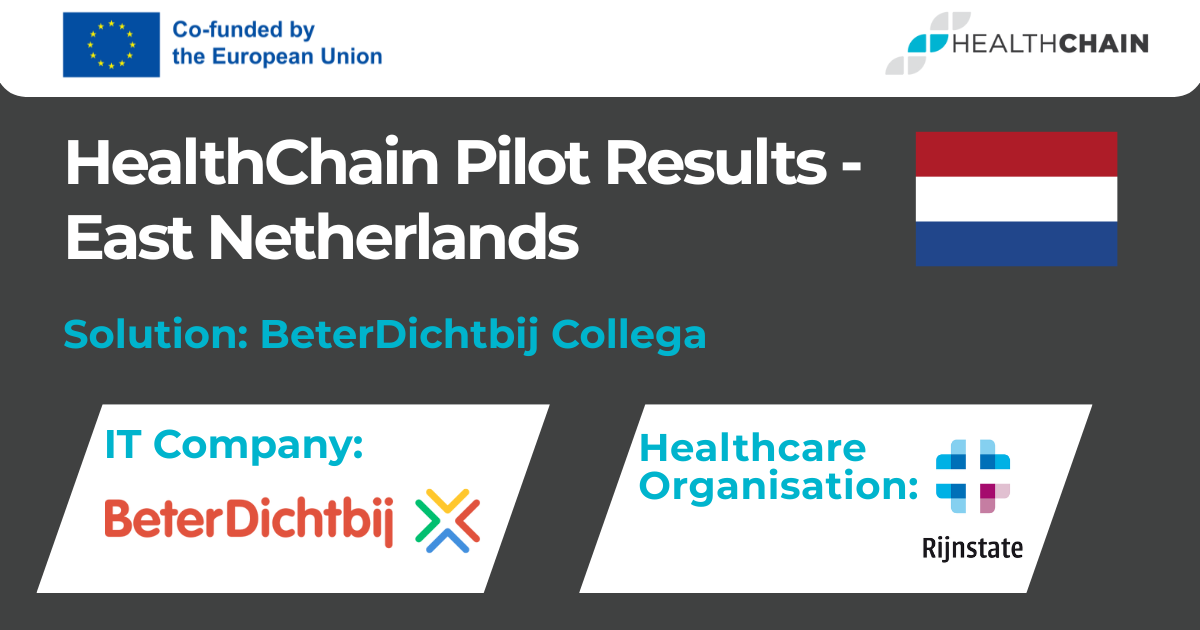
After being discharged from the hospital, patients often receive wound care at home. Good, regular coordination between hospital and homecare organizations is crucial for smooth recovery and for ensuring continuity of care after discharge. However, this continuity has long been under pressure due to fragmented communication channels such as email and telephone. Rijnstate and four homecare organizations have therefore started a pilot in which they collaborate via BeterDichtbij Collega, the digital communication platform for healthcare professionals. Initial results show that professionals can reach each other faster, there are fewer disruptions during patient contact, and the quality of wound care improves because everyone is directly informed through short lines of communication.
The Challenge, the Solution and the Co-creation Process
Good wound care requires careful follow-up, well-aligned coordination between care teams and the ability to respond quickly when a situation changes. In practice, this proved challenging. Communication between Rijnstate and the homecare organizations mainly took place via email or telephone, making it difficult to reach the right professional at the right moment. As a result, questions about wound care were not always addressed in a timely manner, and care moments were regularly disrupted by interruptions or delayed responses.
BeterDichtbij Collega provides a solution to that issue: Care teams from Rijnstate and the involved homecare organizations can communicate with eachother in an accessible and secure manner for each individual patient. Messages reach the right healthcare professional directly, allowing questions to be answered faster and everyone to be immediately informed of the situation.
This creates a form of co-creation: professionals have joint insight, can better anticipate and experience more peace and efficiency in their work. This directly contributes to the quality and continuity of wound care for patients at home.
Pilot Overview, Results and Lessons Learned
The pilot started on June 16 2025, and took place between Rijnstate and four homecare organizations: Wondzorg Arnhem, STMG, Thuiszorg Groot Gelre and Attent. During the pilot, BeterDichtbij Collega was used to support communication around wound care. Professionals indicated in evaluations that the work has become faster, more transparent and more efficient. This was positively confirmed in the evaluation discussions:
“It works pleasantly, faster and more efficient. Nice that everyone is immediately informed. BeterDichtbij works better than the previous systems,” says Stefan Nienhuis, Wondzorg Arnhem.
“I’m so used to BeterDichtbij that I have to switch gears to work the old way with parties we haven’t yet deployed this with. I still have a few major parties I’d like to start the collaboration with,” according to Roland Toeter, Rijnstate.
The results show that healthcare professionals can reach each other faster and more directly, because communication about patients is clearly separated from regular email. This provides overview and gives involved teams better visibility into the healing of the wound, which benefits the quality of care.
For Rijnstate, this mainly means that the use of BeterDichtbij Collega improved communication with homecare organizations and resulted in more efficiency and reduced pressure on care. Community care teams can carefully manage aftercare at home and only escalate back to the hospital when the wound actually deteriorates. This contributes to greater stability and continuity in hospital care.
The new way of collaborating also brings clear benefits for home-care organizations. They can respond faster and are assured of good accessibility to the hospital. This enables them to act more effectively, and patients less frequently need to wait for advice or return to the hospital when questions arise about a wound.
During the pilot, it also became clear how important it is that teams are jointly responsible for communication. In the initial phase, delays sometimes occurred when messages were picked up by one person who turned out to be absent. After the first evaluation, it was agreed to always organize communication as a team. Since then, the process has been more consistent and this bottleneck has not recurred.
Future Plans
Rijnstate and BeterDichtbij will explore the possibility to continue the collaboration and to further scale the solution. Whether the collaboration will be continued and expanded to additional teams or organizations depends on regional decision-making. BeterDichtbij has the ambition to be the national communication platform in healthcare, enabling hospitals, homecare organizations and other healthcare providers to collaborate digitally in a secure and accessible way.
Disclaimer: HealthChain project is funded by the European Union. Views and opinions expressed are, however, those of the author(s) only and do not necessarily reflect those of the European Union or European Innovation Council and SMEs Executive Agency (EISMEA). Neither the European Union nor the granting authority can be held responsible for them.